Release timing is provisional and subject to change.
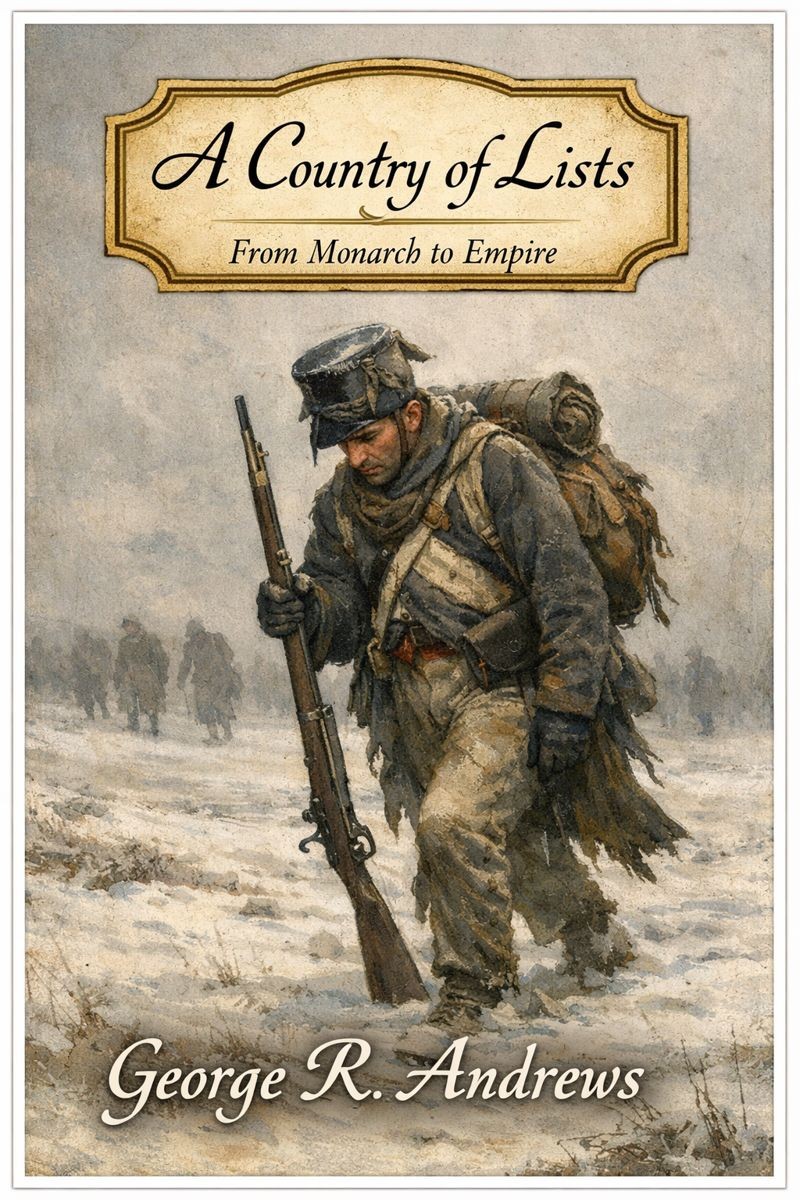
A Country of Lists
From Monarchy to Empire
In the winter of 1788, the village of Saint-Romain-sur-Ouche lived on thin bread, vines, and whatever warmth could be coaxed from a hearth. Gaston Émile Augustin Lemaire wakes to frost in the beams and his mother’s cough, while his father measures the day in work and worry: keep the vineyard alive, keep the family fed, keep dignity where the season offers none.
Then the world beyond Burgundy begins to arrive in the village like weather—first as talk, then as pressure, then as something you can’t ignore. Hope comes with slogans about liberty and rights; fear comes with notices nailed to boards and names copied into ledgers. Jean-Luc Baptiste Fournier, raised in a household where flour dust is as familiar as prayer, learns quickly that in this new France the most dangerous weapon is often a pen: a careless remark can become a line on a form, and a line on a form can turn neighbours into witnesses.
As monarchy fractures and the Revolution hardens, Saint-Romain becomes a place where loyalties are weighed in whispers. Aristocrats vanish behind wagon curtains; ambitious men like Étienne-Henri Bouchard discover that survival can look a lot like enthusiasm. The village keeps planting, keeps baking, keeps pretending at everyday life—while learning the new arithmetic of accusation and compliance, and the brutal lesson that the safest thing you can be is uninteresting.
And when the Terror finally loosens its grip, the promised “peace” does not mean rest. It means administration on paper. Under the Empire, the demands arrive politely—revision notices, quotas, tariffs—each one backed by the same threat. The state does not need men to be brave; it needs them to be usable.
By 1811, the lists reached into the bodies of young men. Names are called; hands disappear into a box; a number is unrolled and spoken aloud, and futures shift on a strip of paper. Soon the road leads far beyond Burgundy—towards bitter marches, freezing rivers, and the kind of “glory” that eats the people who supply it.
Spanning from the hunger of 1788 to the bruised returns of 1813, A Country of Lists is an intimate epic about ordinary lives caught in a nation’s reinvention—about friendship tested by policy, families stretched by impossible choices, and the quiet question that follows every regime change: when the world is remade in ink, what does it take to stay human?
Release
13 March 2026 (Tentative)
e‑ISBN
978-1-998497-74-4
Paperback ISBN
978-1-998497-75-1
Hardcover ISBN
978-1-998497-77-5
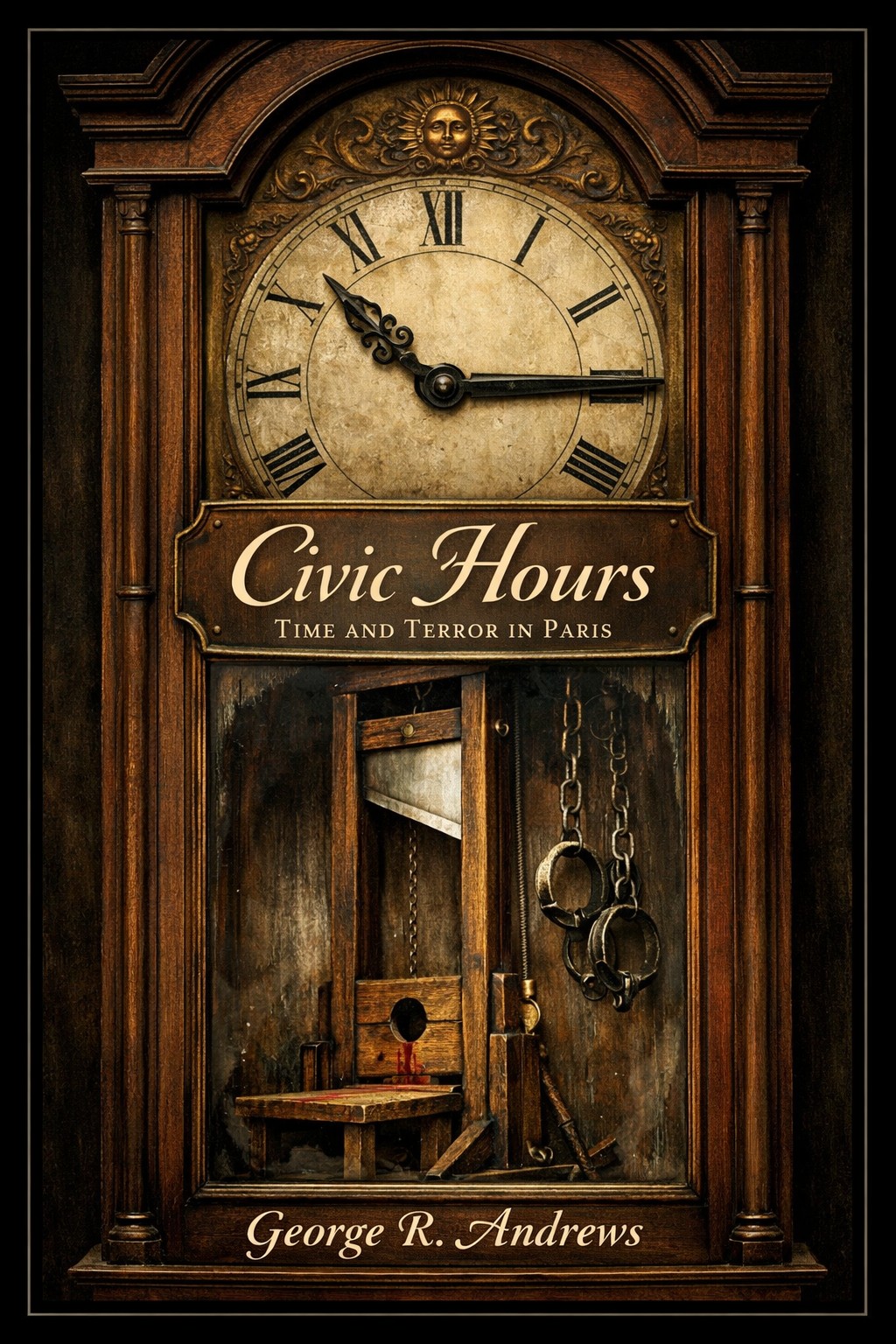
Civic Hours
Time and Terror in Paris
In the winter of 1788, clockmaker Étienne Marceau learns that a life can be condemned by ink as easily as by hunger. A huissier’s wax seal makes his lathe “illegal by a thumbprint of wax”, and debt becomes a public label he cannot scrape off. With his future narrowed “neatly, in red wax”, Étienne leaves Auxerre for Paris—less a dream than a calculation: to remain what he is, or to disappear into the city’s appetite.
Paris does not reward the careful. At the lodging-house on the Rue des Gravilliers, his passport is taken “for safe-keeping”, and he is entered into yet another ledger while neighbours listen from behind shutters. ‘Paris has more of everything,’ the concierge tells him—‘and more lists.’ Madeleine Delaunay, practical and unsentimental, warns him not to be clever, because ‘Paris makes liars of people who think they’re honest.’ Étienne takes work where he can, and brings in Lucien, an apprentice hungry for recognition in a city that punishes being unnoticed almost as quickly as it punishes being seen.
Then the Revolution begins to reshape the very hours. The Republic demands new measures, new oaths, and even a redesigned day, and committees with good handwriting begin to notice the useful tradesman with “clean hands” and a reputation for accuracy. Étienne is summoned to inventories—asked to identify, to sign, to make order out of other people’s lives—because, they insist, he “will not steal”. Refusal is never just refusal; it becomes a note, and notes become lists, and lists become prisons. His name is posted, his duties are assigned, and the countdown begins: “Eight days. A face to paint. A sentence to speak. A list already written.”
When suspicion hardens, Étienne discovers what happens when paperwork starts to breathe. His own ledgers become evidence; an accusation can hinge on “names insufficiently annotated”. The city’s language grows flexible—arrested, summoned, detained—while clerks ask not what a man has done, but what the paper says he has done. Even in his workshop, the old tick begins to sound less like time and more like counting. Under keys and candles, the calm power of a list is this: to exist on paper is to be handled. And when the cart finally turns “towards the river, and the darker buildings beyond”, Étienne must decide what he owes to survival, to his craft, and to the people whose names pass through his hands—before time, remade by decree, runs out.